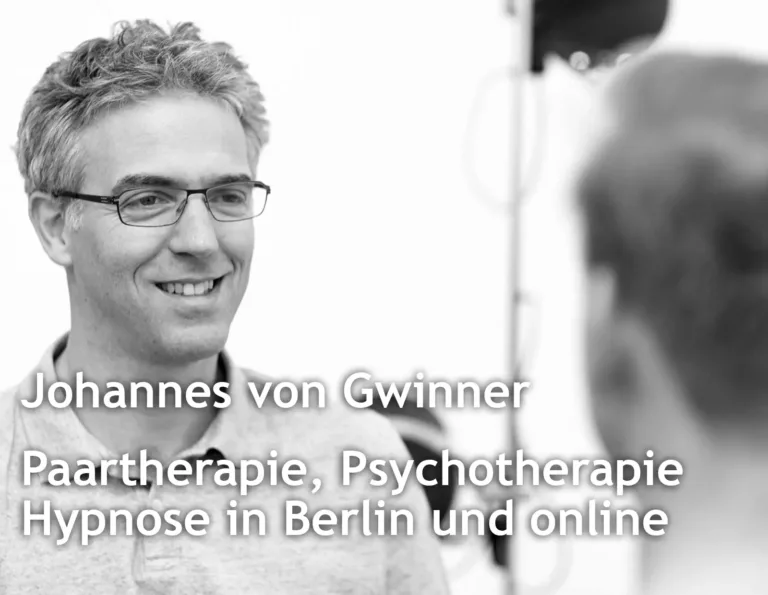
Hypnosis According to Milton Erickson – Gentle Hypnotherapy in Berlin
- Would you like to find a gentle, indirect path to inner change?
- Are you looking for a method built on your own resources rather than rigid instructions?
- Do anxiety, tension, or entrenched patterns keep holding on?
- Are you curious about trance experiences but want to stay in control?
- Would you like hypnotherapy in person in Berlin-Mitte or conveniently online?
Hypnosis – The Power of Inner Change
Hypnosis is a proven method for reaching the subconscious in a targeted way and enabling profound change. Ericksonian hypnotherapy, named after the psychiatrist and hypnotherapist Milton H. Erickson, uses indirect suggestions, metaphors, and storytelling to encourage positive transformation gently and sustainably.
Briefly explained: Hypnosis according to Milton Erickson (Ericksonian hypnotherapy) is a gentle form of hypnosis that works with indirect suggestions, metaphors, and stories rather than direct commands. It uses what every person already brings with them – experiences, images, strengths – to initiate change at their own pace. It was developed by Milton H. Erickson (1901–1980), an American psychiatrist and arguably the most influential hypnotherapist of the 20th century.
What Is Hypnosis? A Natural State Everyone Knows
Hypnosis is a natural state of focused attention in which conscious thinking recedes into the background and the subconscious becomes more receptive to new impulses. Everyone knows trance-like states like this from everyday life: daydreaming, becoming absorbed in a book, or driving a long, familiar route. Therapeutic hypnosis makes deliberate use of this natural mechanism – to loosen entrenched patterns of thought and behavior and regain inner freedom of movement. Throughout, you remain responsive and stay in control; hypnosis is not sleep and not a loss of will.
Ericksonian Hypnotherapy – Gentle and Effective Change
Milton Erickson developed a unique style of hypnosis based on gentle guidance and indirect suggestions. Instead of direct instructions like “Close your eyes and relax,” Erickson used metaphorical stories that actively engage the subconscious. This method is especially well suited for people who resist traditional hypnosis techniques.
Rather than telling the client what to do, Erickson opened up possibilities: “You might like to close your eyes when you notice your eyelids becoming heavier.”
A core principle of Erickson’s work is what’s known as utilization: everything a person brings with them – their experiences, their language, their quirks, even their skepticism – is not treated as an obstacle but used as material for change. That’s why there is no one-size-fits-all approach in this work: every trance is as individual as the person experiencing it.
Indirect Hypnosis – The Power of Suggestion
This gentle form of suggestion allows the subconscious to accept change without resistance. This creates a deep inner acceptance that makes lasting transformation easier.
Ericksonian Hypnosis in Practice
Hypnosis can be used to support a range of concerns, including:
Anxiety and panic: understanding and releasing subconscious fear patterns – more on this at Hypnosis for Panic Attacks
Low mood and exhaustion: making inner resources accessible again – more on this at Hypnosis for Depression
Stress and inner restlessness: developing deep relaxation and calm
Self-worth and limiting beliefs: recognizing and reworking unhelpful inner convictions
Changing habits: e.g. support with quitting smoking or eating behavior
Distressing experiences: combined with trauma therapy, a gentle approach to old pain
Ericksonian elements also find their way into couples therapy – for example, metaphors and stories that open up new perspectives on entrenched patterns, or individual hypnotherapy sessions alongside joint work as a couple.
Hypnosis in My Practice in Berlin-Mitte
I have worked in psychotherapy and hypnosis since 1999, and over many years I have integrated Ericksonian hypnotherapy into my work as a certified psychotherapist (Heilpraktiker für Psychotherapie). In my practice in Berlin-Mitte, I use hypnosis both in standalone sessions and embedded within individual and couples therapy – in person or online via video, always tailored to your concern and your pace. Sessions are held in German and English.
How Does a Hypnosis Session Work?
Every session begins with a conversation: What is this about, what should change, what questions remain open? Only then does the actual trance work begin – sitting or lying down, with eyes closed or open, whatever feels right for you. You hear my voice, remain responsive, and can end the trance at any time. Afterward, we discuss what you experienced and how it can be carried over into your everyday life. A first session usually lasts 90 minutes, follow-up sessions 60 minutes.
Hypnosis as a Gentle Path to Change
Through targeted hypnosis techniques, new perspectives can be developed and inner resources activated. Ericksonian hypnotherapy focuses on strengthening your own abilities in order to anchor positive change for the long term.
If you’d like to find out whether hypnosis is the right path for your concern: in a free 15-minute initial conversation, we can clarify this together – no obligation, by phone or via Zoom.
FAQ – Hypnosis According to Milton Erickson
What Distinguishes Ericksonian Hypnosis From Classical Hypnosis?
Classical hypnosis works with direct instructions (“Your eyes are getting heavy”). Ericksonian hypnosis instead uses indirect suggestions, metaphors, and stories, adapting to the individual person. This makes it especially suitable for people who respond to direct commands with inner resistance.
Do I Lose Control During Hypnosis?
No. Hypnosis is a state of focused attention, not a loss of will. You hear everything, remain responsive, and can open your eyes and end the trance at any time. No one does anything under hypnosis that contradicts their values.
Can Everyone Be Hypnotized?
Generally, yes – trance is a natural state everyone knows from everyday life. How easily someone enters trance varies from person to person. This is exactly where the strength of the Ericksonian approach lies: it adapts to the person, not the other way around.
What Does Trance Feel Like?
Most people describe it as a pleasantly relaxed yet alert state – similar to the moment just before falling asleep or becoming absorbed in a good book. Thoughts are free to come and go; there is no “right” or “wrong.”
What Is the Difference From Stage Hypnosis?
Stage hypnosis stages fast, spectacular effects for an audience. Therapeutic hypnosis is the opposite: a protected, calm setting focused solely on your concern – no audience, no tricks, at your own pace.
How Many Sessions Are Needed?
That depends on the concern. Some issues show noticeable movement within just a few sessions, while others require a longer process – especially when hypnosis is embedded within individual or couples therapy. In the free initial conversation, I’ll give you an honest assessment.
Does Health Insurance Cover the Costs?
As a certified psychotherapist (Heilpraktiker für Psychotherapie), I cannot bill statutory health insurance. Private supplementary insurance for Heilpraktiker services covers the costs fully or partially, depending on the tariff. Details can be found on the prices page.
Schedule a No-Obligation Consultation
- I offer individual, no-obligation consultations by phone at 030 54907420 or by email: office@johannes-gwinner.com
- Leave your contact details below and I will be happy to get back to you.
- Book a free consultation online here:
https://johannes-gwinner.com/termine-fuer-paartherapie-oder-psychotherapie/
10179 Berlin (Mitte)
(Buzzer: Körperraum Mitte, 2nd floor, left)
Phone — Email
More stories from my clients.
Information on prices and packages for hypnosis and psychotherapy in Berlin Mitte.
Send a Message:
Contact
Address
10179 Berlin (Mitte)
(Buzzer: Körperraum Mitte, 2nd floor, left)