Couples Counseling & Couples Therapy Online
- Do your conversations keep ending in a fight – or in silence?
- Do you live in different places or have a long-distance relationship?
- Do you live abroad and want couples therapy in German?
- Do you wonder whether your children are suffering from your conflicts?
- Would you like support – conveniently and confidentially from home?
Do your conversations keep breaking down at the same point? Do you feel like you’re no longer understood by the person who should be closest to you? Perhaps there’s also a quiet exhaustion from trying so many times – and worry about what all of this is doing to you, and perhaps to your children.
For many couples, the path into a practice isn’t just a personal hurdle: the distance, the full everyday life, living in two different places. That’s why I offer couples counseling and couples therapy online via video – in German and English, with the same care and the same methods as in my practice in Berlin-Mitte.
Couples Counseling Online at a Glance
Couples counseling online – often also called couples therapy online or marriage counseling online – is comprehensive support for couples via video session, using the same methods and the same confidentiality as in the practice.
- Format: Video session via Zoom; joining together from one location or separately from two locations is possible
- Duration: approx. 90 minutes per session
- Languages: German and English
- Initial consultation: free, approx. 15 minutes (phone or Zoom)
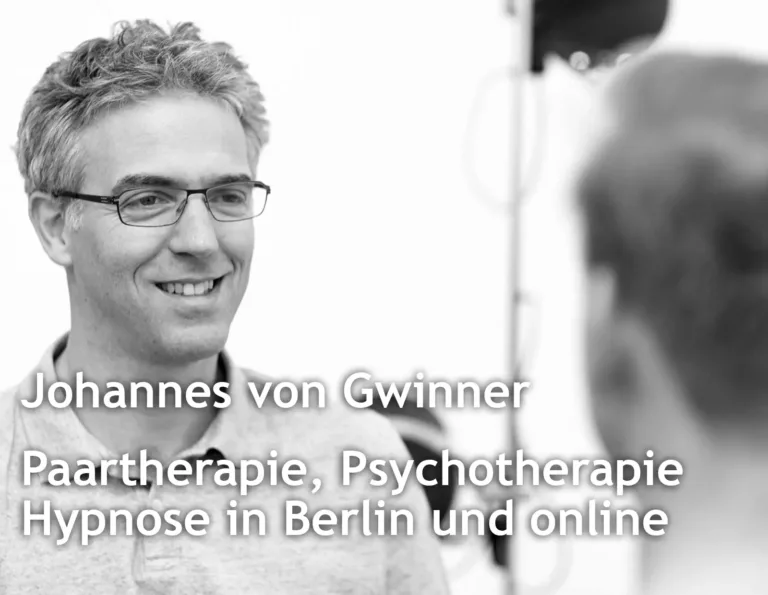
- Therapist: Johannes von Gwinner, licensed psychotherapy practitioner (Heilpraktiker), practice in Berlin-Mitte
- Alternative: Sessions are also possible in person in Berlin-Mitte; both formats can be combined
- Cost: see Prices page
When Online Couples Counseling Is the Right Path
The concerns couples bring to me are similar – whether online or in person: conflicts that go in circles. Closeness that has been lost. A breach of trust. The question of whether and how to move forward together. What differs is the life situation. Online couples counseling – whether you call it couples therapy, marriage counseling, or relationship counseling online – is especially suitable when:
- You’re in a long-distance relationship. Shared time is precious – often too precious to spend on unresolved conflicts. Online, you can dial in from two locations and work continuously on your relationship without waiting for your next visit together.
- You’re a German- or English-speaking couple living abroad. When the familiar environment is missing, the partnership becomes the most important support – and is under particular pressure at the same time.
- You have children and would need to arrange childcare for every practice appointment. An evening online session, once the children are asleep, is often the more realistic path for many parents.
- Your schedule leaves little room – without travel time, a 90-minute session fits more easily into everyday life.
- You feel more comfortable in your own, familiar surroundings and can speak more openly there.
Regardless of the format: a relationship doesn’t need to be in a deep crisis first. The earlier you get support, the easier it is to change entrenched patterns!
Couples Counseling or Couples Therapy – What’s the Difference?

The two terms are usually used interchangeably in everyday life – even the classic term “marriage counseling” means the same thing: support for couples, married or not. If you want to distinguish between them: couples counseling tends to be more solution-focused and addresses specific concerns – such as recurring conflicts, an upcoming decision, or the need to communicate better again. Couples therapy goes deeper, where old wounds, deep-seated patterns, or each partner’s personal history come into play.
In my work, the transitions are fluid: we start with what you bring – and go as deep as is meaningful and helpful for both of you. As a licensed psychotherapy practitioner (Heilpraktiker), I offer both, online and in my practice in Berlin-Mitte. So you don’t need to decide on a term in advance – in the free initial consultation, we’ll work out together what fits your situation.
How Online Couples Therapy Works – and What Can Change
Perhaps you know this: you only wanted to bring up a small thing. Two sentences later you’re in the middle of the same old argument, everyone’s defending themselves, no one feels heard. Or you’ve stopped bringing things up at all – because you know how it’ll end. Both are exhausting. And neither means you’ve failed as a couple – it means you’re stuck in patterns that are hard to resolve on your own. This is exactly where the work begins, online just as much as in the practice.
First: Stop Triggering Each Other
Before we talk about the actual problems, we make sure that the way you talk to each other doesn’t make those problems worse. “You never listen to me anyway!” becomes, for example: “When you look at your phone while we’re talking, I feel unimportant. I’d like us to really listen to each other for a few minutes.” The same pain – but expressed as your own feeling and wish instead of an accusation. The 3‑W rule helps here: What do I perceive? How does it affect me? What do I wish for? Many couples already experience this first step as a relief: it becomes possible again to say something without it escalating.
→ In detail: Nonviolent Communication in Couples Therapy
A Safe Space – Even on Screen
In everyday life, many couples find it hard to talk about what really matters: conversations escalate, so they’re avoided – and feelings pile up. A Zoom session creates that space: with me as an impartial third party making sure both of you are heard. Something special almost always happens: when you listen while the other person works with me, you often understand for the first time why a certain behavior pushes one of your “buttons” – because it touches on much older or unconscious experiences that have nothing to do with you. “You want to hurt me” becomes “Ah – that’s what’s happening inside you.” Many couples describe exactly that as a turning point.
→ More on this in the article: Red Buttons in Relationships – Why It’s Precisely Our Partner Who Can Hurt Us So Easily
Recognizing Patterns: Why It Always Plays Out the Same Way
In strained relationships, two opposing reactions often feed into each other: one person gets louder, the other withdraws – the withdrawal makes the first one even louder, the loudness makes the other even quieter. Both suffer, both feel helpless, and neither can get out of the spiral alone. In couples therapy, we make these patterns visible. Then the other person’s behavior no longer needs to be taken personally – and many couples experience deep relief: you start working together on a shared problem again, instead of against each other.
→ More on this in the article: Why Arguments Always Play Out the Same Way – Recognizing and Changing Relationship Patterns
From the Session Into Everyday Life
Everything worked out in the sessions is meant to arrive where your relationship actually happens: in your everyday life. We discuss specific behaviors and small routines, and in follow-up sessions we look together at what’s working and what’s still difficult. This path often begins with forgiveness: unspoken hurts sooner or later keep causing conflict – once voiced and truly heard, it becomes possible to apologize and, where possible, to genuinely forgive. Then they lose their weight.
→ More on this in the article: Forgiveness in Partnership – How Hurts Lose Their Weight
What About the Children?
If you have children, you’re probably carrying a second concern: what do the kids pick up on, and do they suffer from it? Children sense tension very precisely – even when there’s never a loud argument. This isn’t about assigning blame, quite the opposite: it’s one of the strongest reasons to get support. Because parents who learn to handle conflict respectfully and reconcile again give their children something immensely valuable. Many parents describe it as a great relief when noticeably more calm returns home – for the relationship, and for the children, who can finally breathe easier. A guided, child-appropriate separation is part of this too.
→ More on this in the article: What Children Learn From Their Parents’ Conflicts
Individual Sessions and Patience
Some issues have their roots in one’s own childhood or in difficult past experiences – and some things people initially prefer to talk about alone. That’s what complementary individual sessions are for, also available online; you decide for yourself what, if anything, later flows into the joint sessions.
And: behavior patterns have become habits and change bit by bit, not overnight. Patience – with the other person and with yourself – is one of the most important foundations. The good news: many couples experience an initial sense of relief early on, often simply because they’re finally talking again and both feel heard.
What Can Even Be Easier in Online Couples Therapy
Many people open up more easily in their familiar surroundings – your own sofa lowers the barrier, especially for the first appointment. If you live apart, the online format is what makes continuous couples therapy possible in the first place. And the research confirms it: video-based couples therapy is comparably effective to in-person sessions for most concerns.
Couples Therapy Online: How a Session Works
After booking, you’ll receive a video link by email (Zoom) in advance. You can dial in together from one location or separately from two – both are possible. The content of the session doesn’t differ from an in-person appointment: we take time for your situation, make burdensome patterns visible, work on your communication, and develop next steps together. A session usually lasts about 90 minutes. If you’d first like to find out whether online couples therapy is right for you, book a free 15-minute initial consultation (phone or Zoom).
Here’s how easy it is to get started:
- Book a free initial consultation (approx. 15 min., phone or Zoom)
- Choose an appointment – you’ll receive the Zoom link by email in advance
- First session (approx. 90 min.) – together from one location or separately from two
When an In-Person Session Is the Better Choice
I’ll say it openly: the online format isn’t the best solution for every situation. Some couples need precisely that physical separation from everyday life – a neutral place that isn’t their own living room. Even if a truly undisturbed setting isn’t possible at home, an in-person appointment is often more suitable. In very acute crises, I’ll discuss with you in the initial consultation which setting is appropriate. I also offer couples therapy in person at my practice in Berlin-Mitte – both formats can be combined flexibly.
Technology and Preparation – Easier Than Many Think
You don’t need any special equipment: a stable internet connection and a laptop, tablet, or smartphone with camera and microphone. Access is via a link in your browser or the Zoom app – installation is usually not required. Recommended: a quiet, undisturbed place, headphones, and a few minutes to transition after the session.
Confidentiality and Data Protection in Online Couples Therapy
Just as in person, online sessions are subject to therapeutic confidentiality. The video connection is encrypted. For your part, please make sure you have a private location for the session. Details in the privacy policy.
Challenges for Intercultural Couples
Intercultural relationships can be enriching – and at the same time bring particular challenges.
Different cultural backgrounds, languages, and life realities meet, often in a situation where one person is at home in the respective country and the other isn’t. In such constellations, imbalances can arise that affect communication, closeness, and the shared experience of the relationship.
What role do cultural differences play in a relationship?
Cultural differences often influence fundamental value systems and ideas about living together. Different views on family roles, partnership, raising children, or gender roles can lead to misunderstandings or conflicts – especially when these differences remain unspoken.
Can cultural differences create an imbalance in the relationship?
Yes. When partners come from different cultural contexts, imbalances can arise – for example through differing social integration, expectations, or role models. Such dynamics often work subtly but can affect the emotional balance of the relationship.
How much do language and background shape how a relationship is experienced?
When one person grew up in the respective country and is fluent in the language while the other is still finding their bearings, this can affect independence, social participation, and decision-making processes. These differences can heighten tension or dependency within the relationship.
How do intercultural couples experience social acceptance or rejection?
Interethnic or intercultural couples may encounter social prejudice, subtle devaluation, or even open discrimination. Such experiences can undermine feelings of safety, belonging, and recognition, and can put a strain on the relationship.
How do differing traditions and holidays affect couples?
Traditions, rituals, and holidays hold different meanings across cultures. Deciding which celebrations to observe and how they fit into shared everyday life can be challenging for intercultural couples and can create emotional tension.
What role do social expectations and how others see us play?
Social attitudes toward intercultural relationships vary widely. Negative attributions or a lack of acceptance in the social environment can make a couple’s social life more difficult and place additional pressure on the partnership.
How can couples therapy support intercultural couples with these issues?
Couples therapy offers a protected space to openly reflect on cultural differences, social experiences, and possible imbalances. The aim is to deepen mutual understanding and find a way of relating that does justice to both partners and their backgrounds.
Couples therapy for queer couples
I have worked with lesbian, gay, bisexual and queer couples for many years — and with individuals from those relationships. I bring no assumptions about what a relationship should look like: who takes which role, how closeness and commitment are arranged, whether as a couple or in an open form.
Much of it is no different anyway. Arguments that keep circling. Distance nobody names. The question of whether to continue together.
Some things do come in addition, and they belong here as a matter of course: coming out to family, friends or at work — and what it does to a relationship when the two of you are at different stages. Families who do not acknowledge the relationship. Experiences of rejection that settle into the relationship without originating there. Open and non-monogamous arrangements, without my treating them as something that needs explaining. Wanting children under different legal conditions. And relationships in which one partner is trans or non-binary, and what a transition changes for both.
I do not treat queer couples as a category of their own — it is simply part of the work. Much of what we look at is no different from any other couple, and whatever is specific to the two of you can be spoken about here as a matter of course. Sessions are available in English and in German.
FAQ – Couples Counseling & Couples Therapy Online
Is online couples therapy as effective as meeting in person?
Who is online couples counseling particularly suited to?
Can we join from two different locations?
How does an online couples session work?
How long does an online session last?
What do we need technically for an online session?
Which languages are the online sessions held in?
How confidential is online couples therapy?
Confidentiality is a central foundation of my work. All content is subject to therapeutic confidentiality – regardless of format. The video connection is encrypted.
What happens if the connection drops?
Does health insurance cover the cost of online couples therapy?
Does online couples therapy also help after an affair or a breach of trust?
When is an in-person session the better choice?
How do we book an online appointment?
Do you work with intercultural or binational couples?
Yes — they are a large part of my practice. Many couples in Berlin come from different countries, languages or religious backgrounds. In therapy we make those differences visible instead of treating them as personal failings, and look for a way of living together that neither partner has to give themselves up for. Sessions are available in English and in German.
Do you work with queer couples?
Yes. I have worked with lesbian, gay, bisexual and queer couples for many years. I bring no assumptions about how a relationship has to be arranged — who takes which role, how closeness is organised, or whether you live as a couple or in an open form. Topics such as coming out at different paces, families who do not acknowledge the relationship, or a partner’s transition have a self-evident place here.
Client Testimonials:
Jochen
Johannes hat uns/mich in einer Paartherapie in einer Onlineversion begleitet und hat durch seine einfühlsame Arbeit geschlossene Türen geöffnet, sodass meine Frau und ich durch seine Arbeit wieder eine Gesprächsebene gefunden haben. Johannes versteht seine Arbeit auch in Videokonferenzen sehr gut, die Umsetzung hat uns sehr gefallen. Johannes ist als Paartherapeut sehr zu empfehlen!
Jana
Ich habe mich in der Paartherapie-Begleitung durch Johannes v. Gwinner sehr wohl und angehört gefühlt und ihn als sehr präsent und konstant zugewandt erlebt, was mich direkt eingeladen hat (ohne sozusagen eine “Warmlaufphase” zu benötigen), mich zu öffnen und mit meinem Inneren zu zeigen und “dem, was – wenn auch in meiner Trance – ist”.
Ich habe Johannes auch als sehr konstant in seiner Neutralität/“Unparteilichkeit” erlebt, er war uns beiden gegenüber offen und aufmerksam.
Ich habe mich sehr verstanden gefühlt, das hat gut getan.
Auch habe ich mich in unserer Dreier-Konstellation direkt vertraut gefühlt.
Vielen lieben Dank dafür!
Es war für mich insgesamt, vom “Paar-Therapie-Setting” her, ein stimmiges und flüssiges Gefühl.
Arrange a No-Obligation Consultation for the Practice in Berlin-Mitte or Online
- I’ll be happy to advise you individually and with no obligation at 030 54907420 or by email: office@johannes-gwinner.com
- Leave your contact details below and I’ll be glad to get back to you.
- Book a free consultation online here:
10179 Berlin (Mitte)
(Buzzer: Körperraum Mitte, 2nd floor, left)
Phone — Email
More stories from my clients.
Information on prices and packages for hypnosis and psychotherapy in Berlin Mitte.
Jetzt kostenlose Beratung buchen, ca. 15 Min
Sie werden zum online Dienst Calendly weitergeleitet, wo Sie ein Datum und eine Uhrzeit auswählen können. Sie erhalten eine E‑Mail Erinnerung und auch die Möglichkeit, Termine zu ändern oder zu stornieren.
Paartherapie-Termin buchen
Sie werden zum online Dienst Calendly weitergeleitet, s.o.
Kontakt
Adresse
Neue Jakobstraße 1–3
10179 Berlin (Mitte)
(Klingel: Körperraum Mitte, 2. OG links)
Hypnosis
Certificate in Clinical Hypnosis A.C.H.E. American Council of Hypnotist Examiners — Mentor of the Leela School


Licensed Psychotherapy Practitioner (Heilpraktiker)
Certified Practitioner Pantarei Approach